

If you could ask your trendy best friend for recommendations on what to do on vacation, wouldn’t you?
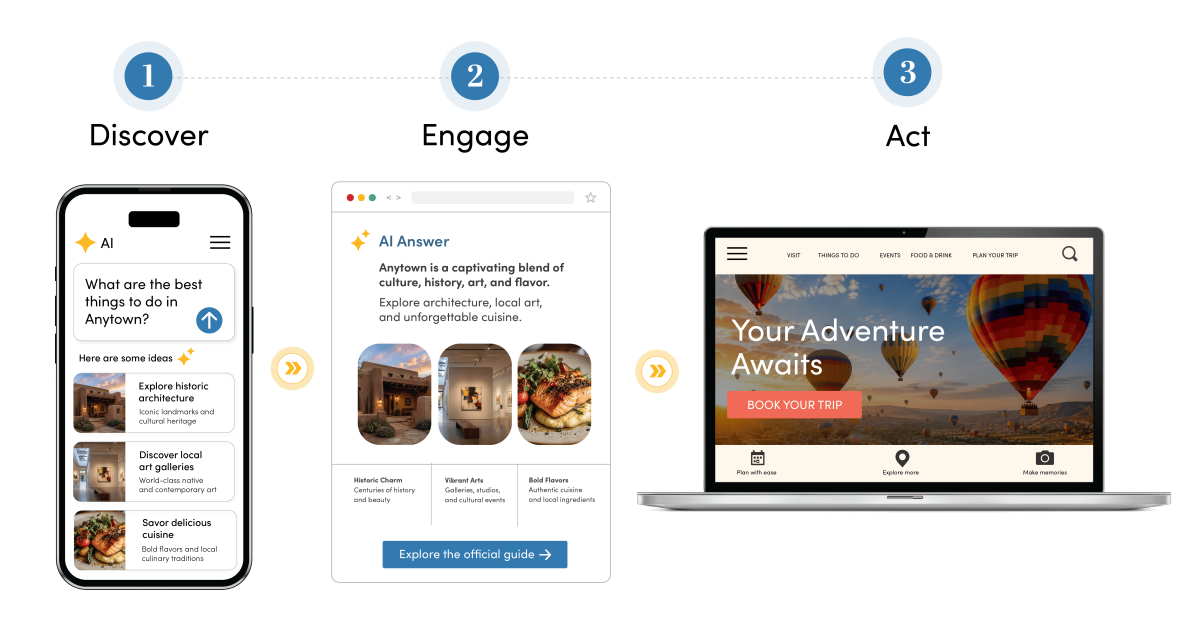
For many, it’s becoming second nature to begin trip planning by opening ChatGPT, Gemini, or Google's AI Overviews and asking questions the way they'd ask a friend. “Where should I eat tonight?” “What's happening in town this weekend?” “Is this hotel worth the price?”
According to Phocuswright, 56% of U.S. leisure travelers used AI for at least one trip in 2026 — up from 43% just nine months earlier. In fact, Phocuswright called it the “fastest behavioral shift the travel industry has seen in more than a decade.”
A recent Adobe study found that traffic from AI sources to U.S. travel websites grew 194% year over year, and 86% of travelers said an AI assistant improved how they researched, planned, and budgeted their trip. Findings revealed that once travelers land on a site through an AI referral, they stay longer and leave less often than visitors who arrive through traditional search.
For destination marketing organizations (DMOs), this trend is already showing up in traffic logs. Our team recently reviewed ChatGPT activity across DMO websites and found that in one eight-day period this spring, ChatGPT made nearly two million requests to DMO sites looking for answers to traveler questions. Almost half of those requests pulled from individual listing pages — like the attractions, restaurants, hotels, and tours that make up the bulk of a destination site.
Simpleview CMS was rebuilt to present your content to search engines and AI systems. Here's what changed, why it matters, and what it does and doesn't do for you.
What happens when AI visits your page
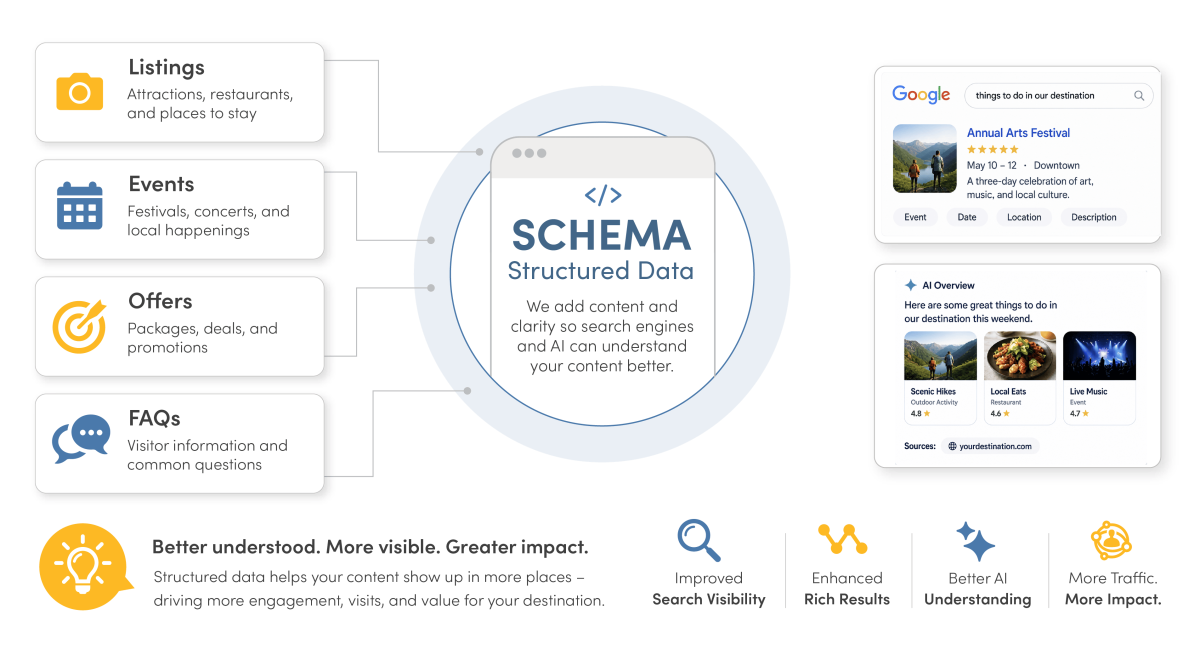
A website visitor observes all the work you put into your site; your photos, bold headlines, descriptions, and layout build visual interest in your destination. An AI system reading the same page does not consume any of those details. Without proper labels, a listing page is a wall of text and images with no reliable way to tell which number is a phone number, which is a price, or whether the hours listed are current.
Structured data helps to solve that problem. Written in a format called JSON-LD, it adds a hidden layer behind the content your team manages. Structured data tells search engines and AI systems what each piece of information represents; it is not visible to travelers on the page but gives crawlers cleaner information to review.
Think of it as subtitles for your content. The performance story still comes from having meaningful content that travelers are searching for; the purpose of schema is to make sure that content is legible.
Google's own developer documentation describes this type of structured data as a way to help Google understand entities like people, places, and events — and it recommends JSON-LD as the preferred format. Google also notes that there's no special extra markup required to appear in AI Overviews or AI Mode. Those features draw from the same search index as regular results.
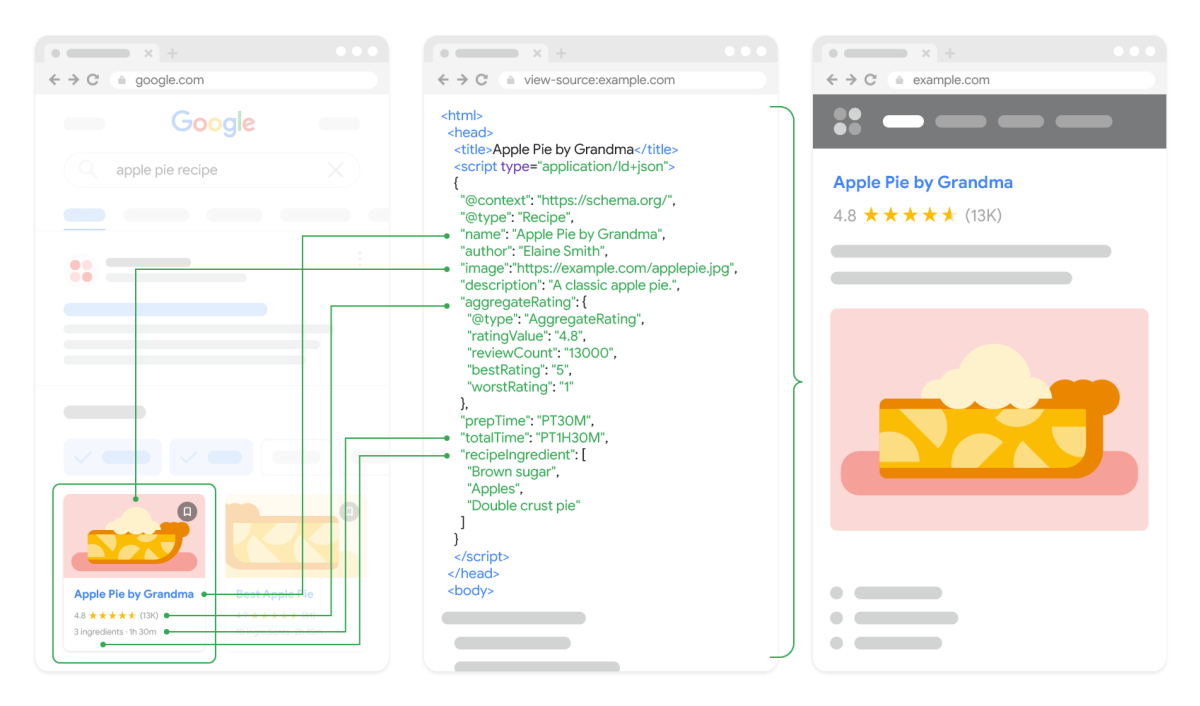
Credit: Google Search Central. (n.d.). Intro to structured data. Google Developers.
Structured data may not be a magic trick that gets your destination featured in an AI answer; however, it does remove ambiguity. It reduces the odds that an AI system misreads your hours, misattributes a price, or skips a listing because it can't confidently tell what the page describes.
Google's structured data guidelines explicitly state that:
- Markup has to match what is visible on the page.
- Information has to stay current at all times.
- Content that's missing or misleading loses eligibility.
What was measured and what changed
Every destination site is built differently, so we measured the CMS components that can carry structured data — like listings, events, offers, blogs, collections, search, maps, and the site identity that sits on every page. We ignored chrome that should never be marked up, like weather, translation, admin tools, and similar.
Nearly nine in ten of the CMS building blocks that should describe a destination to Google and AI now carry structured data, not 89% of every widget on the site. Weather, translation, and admin tools are not supposed to have schema. That includes destination identity on every page, partner listings, events, offers, stories, collections, search, and maps.
After the rollout
There are 16 component types that previously had no structured data that now have it — including sitewide Organization and WebSite, breadcrumbs, page and collection types, list and feed templates, search results, and maps.
Every component that already existed was rebuilt into one connected page graph instead of isolated standalone snippets.
On listings, events, offers, and blogs, the share of fields the CMS sends went from 64% complete on average to 100% of the current builder. Offers saw the biggest jump.
Early client sites moved quickly in our structured data benchmarks. The strongest live example scored 4.1 out of 5 because homepage, lists, events, and articles were finally labeled as one destination — not a pile of unrelated URLs.
We also tested live pages across Simpleview CMS client sites using the Adobe AI Content Visibility Checker — a tool that measures how well AI agents can read and cite a page's content. Scores on beta client sites came in at 92–96% citation readability.
A score in the 90s means AI agents can access and process the content. The remaining gap is almost always a content quality issue — thin listing descriptions, missing images, sparse hours — not a schema issue. This confirms the point that schema is the foundation and content quality is the ceiling.
Purpose-built into Simpleview CMS
We reviewed structured data across different pages and have nearly tripled the amount of schema coverage within Simpleview CMS. Every site now carries a consistent Organization and WebSite entity: DMO name, URL, phone number, address, and logo on every page. Breadcrumbs mark where each page sits in the site hierarchy.
Your destination is now on every page — meaning AI systems can treat the site as one official source rather than a collection of disconnected pages. This layer is generated from the content you already manage, with no custom coding per page needed.
| Platform Entity | Schema.org Type | Purpose | Status |
| Client Organization | Organization | Represents the client/business identity | Newly covered |
| Website | WebSite | Defines the primary website entity | Newly covered |
| Current Page / Webpage | WebPage / CollectionPage | Represents rendered pages and collection-based pages | Newly covered |
| Breadcrumbs | BreadcrumbList | Defines navigational hierarchy | Newly covered |
| Articles | BlogPosting | Article content structure | Enriched |
| Articles Collection | ItemList | Collection wrapper for articles | Newly covered |
| Blog | BlogPosting | Blog content structure | Enriched |
| Blog Collection | ItemList | Collection wrapper for blogs | Newly covered |
| Multi Leisure Blog | BlogPosting | Categorized editorial/blog content | Enriched |
| Multi Leisure Blog Collection | ItemList | Collection wrapper for multi leisure blogs | Newly covered |
| Listing | LocalBusiness | Individual business entity | Enriched |
| Listings Collection | ItemList | Collection wrapper for listings | Newly covered |
| Event | Event | Event-based content | Enriched |
| Events Collection | ItemList | Collection wrapper for events | Newly covered |
| Offer | Product + embedded Offer | Product/offers structure | Enriched |
| Offers Collection | ItemList | Collection wrapper for offers | Newly covered |
| FAQ | FAQPage | Frequently asked questions | Newly covered |
Listings: Individual business listings — including restaurants, hotels, attractions, and more — are structured as LocalBusiness entities. Details such as name, description, phone, email, photo, address, and map coordinates are included in each. The rollout included enhancements to listing pages, which represent close to half of the AI traffic hitting DMO sites.
Events: Each event carries a structured start and end date, status (scheduled, cancelled, etc.), category, image, and location — so an AI system can confirm that an event is still happening and where to find it.
Offers and deals: Packages, coupons, and promotions are now structured with pricing, availability, valid dates, and a link back to the business or event the offer belongs to — not a title and date alone.
Blogs and articles: Editorial content across articles, blogs, and multi-leisure blogs is now marked with a headline, author, publish and update dates, categories, and tags — meaning stories can be cited as current destination guidance.
Collections, Search, and Maps: Pages that list multiple items — like restaurant listings or upcoming events — are now wrapped in a list structure, helping AI systems recognize the set of related items on the page rather than treating them as disconnected content. Search result pages and map point feeds now carry a structured shape as well.
FAQs: Frequently asked questions have been marked up as question-and-answer pairs.*
*Please note: Google retired the visual FAQ dropdown in classic search results, so structured FAQ content won't produce that specific search feature the way it once did. FAQPage remains a valid schema type — and clear question and answer content still mirrors how people phrase questions to AI tools — but it's not a guaranteed shortcut to an AI citation.
What happens now
Google has stated that no special schema markup is required to appear in AI Overviews or AI Mode. The new schema simply helps search engines better understand your destination and what it has to offer. This means that accuracy matters more than completeness now more than ever. A listing with a missing photo is a missed opportunity; a listing with the wrong phone number, or an event marked as scheduled after it's been cancelled undermines the accuracy both AI systems and travelers are relying on.
The schema Simpleview CMS generates is only as good as the content behind it. A few habits make a real difference:
- Adding at least one real, current photo to every listing and event.
- Writing a clear description in plain language rather than marketing copy alone.
- Keeping hours and pricing current, especially around seasonal changes.
- Double-checking that addresses and map pins are accurate.
None of these steps require rebuilding your content strategy. If partner listings are difficult to keep fully updated, we recommend that you start with the basics. If you want to improve visibility for partners, share this short checklist with them:
- Current phone number
- Accurate address
- One strong photo
- A clear description of offerings
Why it adds up
As Dave Corner, senior director of destination experience, explained in a recent interview, DMO websites are becoming less of a digital brochure and more of a living knowledge base that AI systems draw from directly. The destinations that keep their content accurate, complete, and clearly labeled will be the ones AI systems can confidently recommend.
If you have questions about how this rollout affects your site, reach out to your Granicus Destinations account team.