The travel planning journey has been completely reshaped over the past two decades. We’ve moved from travel agents and paper maps to online booking engines and Google Maps. Now, we stand at the beginning of another monumental shift, one driven by artificial intelligence. Conversational AI tools like ChatGPT and integrated search experiences like Google’s AI Overviews are changing how travelers find inspiration, ask questions, and build itineraries.
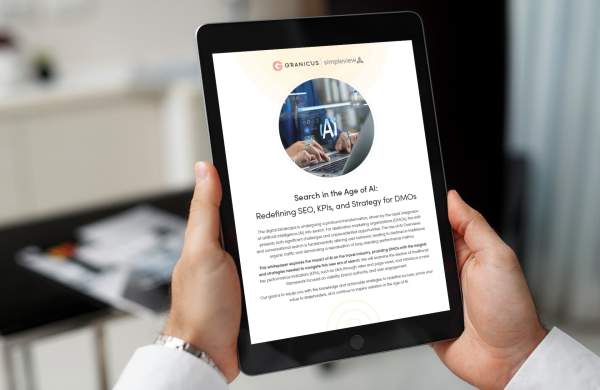
Search in the age of AI: Redefining SEO, KPIs and strategy for DMOs
Learn the strategies DMOs need to stay visible, credible, and competitive in a rapidly evolving…
For destination marketing organizations (DMOs), this evolution presents both a challenge and an incredible opportunity. The old rules of SEO are being rewritten, and the destinations that adapt will be the ones that capture the attention of the next generation of travelers. Understanding this shift is the first step toward future-proofing your marketing strategy and ensuring your destination remains visible in an increasingly AI-driven world.
This is not a trend to watch from the sidelines. It’s time to explore what the rise of AI means for your DMO and what practical steps you can take to position your destination for success.
How AI is transforming the traveler’s journey
Think about the classic travel search process. It often involves multiple tabs, dozens of searches, and cross-referencing information from blogs, booking sites, and review platforms. AI aims to consolidate that entire process into a single, seamless conversation.
Travelers can now ask complex questions and receive curated, summarized answers. Instead of searching "family-friendly restaurants" and then "restaurants with outdoor seating," a user can simply ask: "Show me family-friendly restaurants with outdoor seating near the children's museum that are open for lunch."
AI-powered platforms excel at this by:
- Synthesizing information: Tools like ChatGPT and Google's AI Overviews digest vast amounts of web content to provide a single, comprehensive answer, reducing the need for users to click through to multiple websites.
- Creating personalized itineraries: AI can act as a virtual travel agent, building entire trip plans based on a user's interests, budget, and timeline. It can suggest a full weekend itinerary, complete with hotel options, restaurant reservations, and daily activities.
- Answering hyper-specific questions: AI can find answers to niche, long-tail queries that traditional search might struggle with, such as "Can I rent a kayak that allows dogs near this specific lake?"
This fundamental change means that simply ranking #1 for a broad keyword is no longer the ultimate goal. The new goal is to be the source of truth that AI platforms trust to build their answers.
The implications for Destination Marketing Organizations
The rise of AI-driven travel planning has significant implications for how DMOs approach digital marketing, data management, and stakeholder engagement. Here are a few key areas to consider.
The shift from clicks to content authority
In a world of AI summaries, the "zero-click search" is becoming more common. An AI might pull information from your website to answer a user's question without that user ever visiting your site. While this may sound alarming, it’s not necessarily a bad thing. It signals that your content is authoritative and trustworthy. The new key performance indicator (KPI) is not just website traffic, but "share of voice" within AI-generated responses. Your success will be measured by how often your destination’s information is featured as the definitive answer.
The critical need for structured data
AI doesn't just read words on a page; it ingests structured data to understand context. It needs to know that a specific date is an event, a number is a price, and a location is a physical address. This is where schema markup becomes non-negotiable. Schema is a type of code that you add to your website to help search engines understand your content. Without it, your data is just text. With it, your data becomes a set of clear, machine-readable facts that AI can easily use to build answers.
The heightened importance of fresh, accurate information
Trust is the currency of the AI economy. If an AI tool provides a traveler with outdated information—like incorrect business hours or a canceled event—it loses credibility. As a result, AI algorithms are programmed to prioritize sources that are frequently updated and consistently accurate. A website that is regularly refreshed with new events, special offers, and updated partner listings is seen as more reliable and is more likely to be used as a source.
Actionable steps for DMOs to adapt
Adapting to this new landscape doesn't require abandoning everything you’re doing. It’s about enhancing your current strategies with an AI-first mindset.
1. Make your CRM the heart of your content strategy
Your Customer Relationship Management (CRM) system is likely filled with the most accurate, up-to-date information about your destination's partners, events, and amenities. This operational data is an SEO goldmine. When your CRM is integrated with your Content Management System (CMS), every update made in the CRM can automatically flow to your website, complete with the necessary schema markup. This creates a powerful, automated engine for fresh, structured content.
2. Empower your partners to become content creators
Your team cannot manually manage every detail for hundreds or thousands of partners. The most effective approach is to empower your partners to update their own information. A platform like Simpleview CRM includes a Partner Extranet, a user-friendly portal where stakeholders can log in and manage their own listings. By providing them with this tool, you enable them to:
- Add new photos and update descriptions.
- Post upcoming events and special offers.
- Keep their amenity lists and hours of operation current.
This collaborative approach ensures your data is always fresh while strengthening your relationship with local businesses.
3. Focus on Answering Specific Questions
Shift your content strategy from targeting broad keywords to answering specific, long-tail questions. Think about the detailed queries a high-intent traveler might have. Use your blog and website pages to create content that addresses these needs directly. For example, instead of just a page on "Things to Do," create content around "Rainy Day Activities for Toddlers" or "A Guide to Dog-Friendly Patios in Downtown." The more specific your content, the more likely AI will find it to be the perfect answer for a user’s query.
Embrace the future of discovery
The rise of AI in travel planning is an opportunity for DMOs to solidify their role as the ultimate authority on their destination. By focusing on providing high-quality, structured, and fresh data, you can ensure that your destination is not just part of the conversation but is leading it. This begins with leveraging the right tools to connect your operational data to your marketing strategy.
Simpleview CRM is designed to be the central hub for your destination’s data, built with the integrations needed to power your visibility in the age of AI. By empowering your team and your partners, you can drive economic growth and ensure your destination thrives in this new era of discovery.
Ready to see how your CRM can become your most powerful marketing asset?
Explore how Simpleview CRM can help you streamline operations and prepare your destination for the future of search.
Get started